)
China IP Brief | Dispatches from the Frontiers of IP Law in China
Welcome to the fall issue of China IP Brief, our periodic dispatch bringing you the latest developments in intellectual property law in China.
Look for China IP Brief in your inbox, with deeper dives into developments in China IP law impacting how companies develop, register, maintain and protect their IP rights in the People’s Republic of China (PRC), as well as links to other news, Loeb & Loeb alerts and upcoming events.
Sign up for our China IP Brief by creating an account and selecting China IP Brief as your area of interest here.
In this issue, the Loeb China IP team analyzes the Supreme People’s Court’s (SPC) Opinion on Adjudicating AI-Related Disputes in Accordance with the Law, issued Sept. 7. Comprising 24 articles organized into five sections, the Opinion is the first judicial policy document from the PRC’s highest judicial authority focused on AI-related disputes, and it addresses the liability of generative AI service providers, the allocation of liability and burdens of proof in AI-related IP infringement cases, a new liability exemption for open-source software, patent eligibility and inventorship for AI-related inventions, protection of data rights and interests, and new evidentiary and procedural rules.
We also examine four draft documents comprising supporting rules for the 2026 revision of the Trademark Law of the People’s Republic of China (2026 TML), which takes effect Jan. 1, 2027. Circulated for public comment in September by the China National Intellectual Property Administration (CNIPA) and the SPC, the four draft documents will likely be finalized shortly before or just after the 2026 TML comes into effect. They address examination standards for motion marks, more objective standards for bad faith filings, cancellation of registered trademarks for misleading use, refined suspension rules and transition rules, and are accompanied by a Loeb tracker of the revision progress of the 2026 TML and its supporting rules.
In our Event Spotlight, we report on the July 24 roundtable on the new PRC Trademark Law hosted by Loeb’s Beijing office in collaboration with AmCham China and moderated by Advanced Media & Technology partner Scott Palmer, and we recap the firm’s panel discussion and private reception at the 2026 China Trademark Annual Conference in Xiamen.
In This Issue:
- China’s Supreme People’s Court Issues Its First Comprehensive Guidance on AI-Related Disputes: An IP Enforcement Perspective
- China’s Revised Trademark Law: Draft Supporting Rules Address Examination Standards, Use Obligations and Transition
- Event Spotlights Loeb & Loeb Partner Scott Palmer Leads Roundtable on the New PRC Trademark Law
- Panel Discussion and Private Reception at the 2026 China Trademark Annual Conference
- In Case You Missed It
China’s Supreme People’s Court Issues Its First Comprehensive Guidance on AI-Related Disputes: An IP Enforcement Perspective
On Sept. 7, the SPC issued the Opinion on Adjudicating AI-Related Disputes in Accordance with the Law (Fa Fa [2026] No. 10). Building on the PRC Civil Code, the Personal Information Protection Law, the PRC Copyright Law, the PRC Anti-Unfair Competition Law and other applicable legislation, the Opinion outlines adjudication guidelines based on principles for which a working consensus has emerged in PRC judicial practice. Notably, Article 7 confirms for the first time at the judicial policy level that the traditional internet platform “safe harbor rules” may be applied by analogy to generative AI services, while Article 12 sets out a liability allocation framework and evidentiary rules that may materially lower the barriers to enforcement for rights holders confronting the algorithmic “black box.”
Read more here.
China’s Revised Trademark Law: Draft Supporting Rules Address Examination Standards, Use Obligations and Transition
In preparation for the Jan. 1, 2027, effective date of the 2026 TML, the CNIPA and the SPC circulated four draft documents for public comment in September that will likely be finalized shortly before or just after the 2026 TML comes into effect: the Trademark Examination and Review Guidelines (CNIPA Guidelines), the Measures for Handling Matters under the Revised Trademark Law (CNIPA Measures), the SPC’s Provisions on Several Issues Concerning the Trial of Administrative Cases Granting and Affirming Trademark Rights (SPC Administrative Trial Provisions), and the SPC’s Several Provisions on the Temporal Effect of the Application of the Trademark Law of the PRC (SPC Timing Provisions). The draft documents address how key changes introduced by the revised law would operate in practice in the examination, review and litigation contexts, and they cover a broad range of substantive and procedural changes that warrant monitoring as they move from the draft to final stages over the coming months.
Read more here.
Event Spotlights
Loeb & Loeb Partner Scott Palmer Leads Roundtable on the New PRC Trademark Law
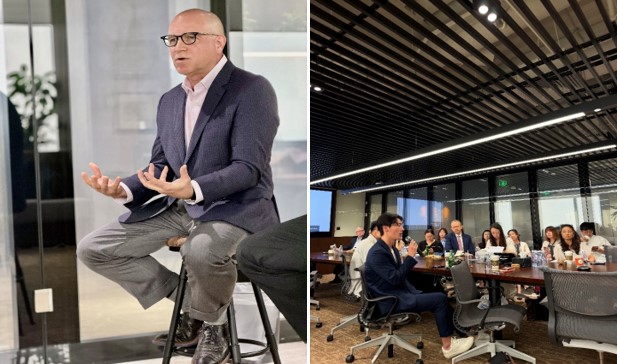
On July 24, Loeb & Loeb’s Beijing office, in collaboration with AmCham China, hosted a roundtable on the new PRC Trademark Law, which will take effect on Jan. 1, 2027. The event brought together in-house counsel from companies with significant intellectual property interests, IP practitioners and other stakeholders to discuss the law’s practical implications.
The panel was moderated by Scott Palmer, Advanced Media & Technology partner at Loeb & Loeb and co-chair of the AmCham China Legal Committee. Scott opened the discussion with an overview of the evolution of China’s trademark law and the context of the latest revision. The panel featured three prominent trademark practitioners from Chinese law firms, who examined key changes affecting trademark registration, scope of protection, prosecution, enforcement, litigation and anti-counterfeiting strategies.
During an engaging Q&A session, participants discussed practical issues involving evidence preservation and enforcement challenges, as well as broader commercial and public-interest considerations arising from the revised law. The roundtable provided a timely forum for assessing the law’s potential impact on trademark protection in China and underscored the value of continued dialogue among companies, practitioners and other stakeholders as China’s trademark landscape evolves.

Panel Discussion and Private Reception at the 2026 China Trademark Annual Conference
Beijing partner Scott Palmer and the senior team—Sue Zhong, Lawrence Zheng, John Huang, Elaine Pan and Harper Li—presented a one-hour session on strategies for addressing bad faith trademark registrations and abusive litigation on Nov. 8 at the China Trademark Annual Conference. Loeb & Loeb is a sponsor of the four-day conference, which took place Nov. 6 – 9 in Xiamen, Fujian Province. The firm hosted a private reception on Nov. 7. Additional information is available on the conference website.
In Case You Missed It
Loeb & Loeb Ranked in 2026 Global 200 List by Law.com International
Loeb & Loeb has been recognized on the 2026 Global 200 list by Law.com International, ranking among the 200 largest law firms worldwide by 2025 gross revenue, rising five spots to No. 146. The firm was also listed as No. 45 on the publication’s list of the 50 largest Asia-Pacific-based law firms by 2025 lawyer head count.
13 Loeb Lawyers Honored in 2026 Edition of IP Stars by Managing IP
Loeb & Loeb and 13 lawyers have been recognized in the 2026 edition of Managing IP magazine’s IP Stars rankings, a leading specialist guide to intellectual property law firms and practitioners worldwide. The 2026 guide recommended Loeb in the areas of Copyright, Trademark, Trademark Disputes and Trademark Prosecution, Patent Prosecution, and Intellectual Property law across six jurisdictions, including nationwide U.S. and China. Partner Scott Palmer was named a Trademark Star, and counsel Sue Zhong was named a Notable Practitioner in China.
Sign up for our China IP Brief by creating an account and selecting China IP Brief as your area of interest here.
-
 Partner
-
 Counsel
-
 Senior Dispute Lawyer - Asia
-
 Associate
-
 Associate
-
Associate