)
A recent decision in a case between Van Leeuwen and Rebel ice creams provides an instructive discussion of trade dress protection for consumer product packaging, the limitations of commonly asserted defenses in packaging cases and the circumstances under which a court may award a defendant’s profits as a remedy for infringement. In the case, Van Leeuwen alleged that Rebel intentionally adopted packaging that was confusingly similar to Van Leeuwen’s distinctive ice cream pint trade dress. Following a bench trial, the court awarded Van Leeuwen Ice Cream approximately $23.8 million in profits attributable to Rebel Creamery’s sales, permanently enjoined Rebel from selling products bearing packaging likely to be confused with Van Leeuwen’s trade dress and ordered Rebel to redesign its packaging.
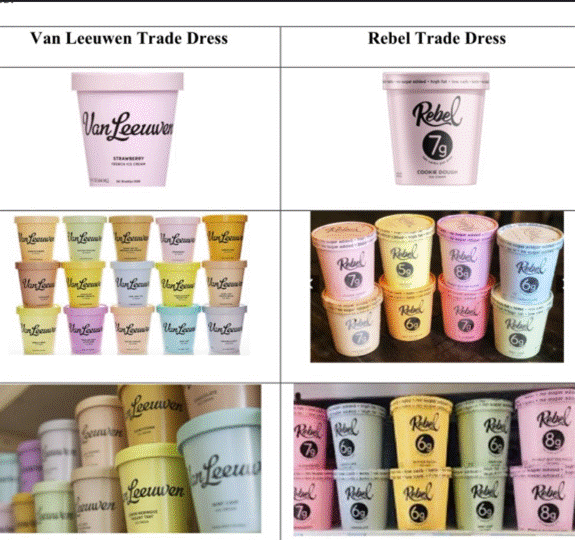
(Source: Complaint, Van Leeuwen Ice Cream v. Rebel Creamery)
The case is notable because Van Leeuwen did not allege that Rebel copied its name or logo. Instead, it asserted that the overall commercial impression created by Rebel’s packaging infringed its protectable trade dress rights. Van Leeuwen defined that trade dress as the combination of various design elements used across its ice cream pint packaging, including its use of monochromatic pints and lids, pastel color palettes, black script lettering, descriptive text and its minimalist overall design.
One of Rebel’s principal arguments was that the individual design elements identified by Van Leeuwen are commonplace within the food industry and therefore are not protectable. The court rejected that argument, explaining that trade dress protection extends to the overall combination of design elements and the commercial impression they create, rather than requiring that every individual component be unique or independently protectable. The fact that particular colors, fonts or layouts may be used elsewhere in the marketplace did not preclude protection where the combination of those elements had acquired distinctiveness and identified a particular source in the minds of consumers.
Rebel also argued that consumers were unlikely to be confused because the parties used different brand names and sold different products. According to Rebel, consumers purchasing keto-focused products would not confuse them with Van Leeuwen’s premium ice cream offerings. The court disagreed, finding that the parties competed in the same retail channels and that consumers frequently make purchasing decisions based upon their overall impressions of product packaging. Differences in names and product positioning were insufficient to outweigh the similarities in the overall commercial impression created by the parties’ packaging.
The court additionally relied upon evidence of actual confusion and consumer perception, including testimony from industry participants regarding the similarities between the products and survey evidence supporting a likelihood of confusion.
Rebel asserted that it adopted its packaging in good faith and that any similarities between the products were coincidental. The court expressly rejected that argument after considering the evidence concerning the development of Rebel’s packaging and witness testimony offered at trial. Those findings informed not only the court’s likelihood of confusion analysis but also its consideration of the appropriate remedies.
The decision also includes a useful discussion of the Lanham Act’s good faith remote user defense. The defense is intended to protect businesses that independently adopt a mark or trade dress in a geographically remote market before learning of another user’s rights. To prevail, however, a defendant must establish both that it adopted the challenged trade dress in good faith and that its use was geographically remote from the plaintiff’s market presence. The court concluded that Rebel failed to establish either requirement. In light of the court’s findings regarding Rebel’s adoption of the challenged packaging, it rejected Rebel’s contention that it independently and innocently arrived at its design choices. The court likewise concluded that Rebel could not establish the type of geographically remote use contemplated by the defense.
The court’s award of approximately $23.8 million in profits is also noteworthy. While trademark plaintiffs frequently seek injunctive relief, awards of a defendant’s profits remain among the more significant remedies available under the Lanham Act and are highly dependent upon the equities of the particular case.
Unlike compensatory damages, which are intended to compensate a plaintiff for its own losses, disgorgement of profits focuses on the gains realized by the defendant from its infringing conduct. The Lanham Act establishes a burden-shifting framework for these awards. Once a prevailing plaintiff establishes the defendant’s gross revenues attributable to the infringing products, the burden shifts to the defendant to prove any deductible expenses and to establish what portion of its profits, if any, is attributable to factors other than the infringement.
Rebel argued that an award of profits was unwarranted because consumers purchased its products for reasons independent of their packaging, including their keto-focused attributes, and that there was no basis to conclude that all of its profits were attributable to the challenged trade dress. Van Leeuwen argued that Rebel’s infringing packaging substantially drove its sales and that any uncertainty regarding apportionment should be borne by the infringer rather than the trademark owner. The court ultimately concluded that Rebel failed to carry its burden of establishing an appropriate apportionment of profits.
The court’s findings regarding Rebel’s lack of good faith permeated both its liability and remedies analyses. The same findings that supported the court’s likelihood of confusion analysis informed its rejection of Rebel’s affirmative defenses and its determination that disgorgement of profits and injunctive relief were appropriate remedies.
For food manufacturers and other consumer products companies, the decision serves as a reminder that packaging reviews should extend beyond trademark clearance analyses. Companies should evaluate the overall commercial impression created by their packaging, particularly when entering categories dominated by well-known competitors. Businesses should also maintain contemporaneous documentation reflecting how and why packaging decisions were made. Evidence of an independent design process may become particularly important if packaging choices are later challenged.
I hope that this information is helpful. Please feel free to contact me with questions.