)
China IP Brief | Dispatches from the Frontiers of IP Law in China
On October 27, 2025, the China National Intellectual Property Administration (CNIPA) announced changes to its delivery protocols for official documents in cancellation and opposition cases through the Q&A section of its official website, stating it will no longer send copies of official notices to the trademark agencies of record. On October 30, 2025, the CNIPA clarified in a follow-up Q&A that the rule applies to all official notices to respond in cancellation, opposition and invalidation proceedings. According to the CNIPA’s brief comments in these Q&A exchanges, official notices will now be sent exclusively to the trademark proprietor at its address of record, with no copy provided to the trademark agency that conducted the relevant filing on the proprietor’s behalf.
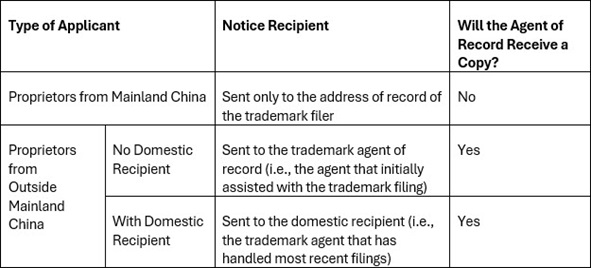
Based on CNIPA’s comments and observations of recent practice, it appears that these changes primarily affect proprietors from mainland China and their China-based agents. For proprietors outside mainland China (i.e., foreign proprietors), the established practice of sending notices to their China agents appears to remain largely unchanged.
Below is a summary of the latest delivery rules for notices to respond involving cancelation, opposition and invalidation proceedings.
Open Issues and Recommendations
As of now, CNIPA has yet to issue a formal announcement clarifying the scope, rationale or implications of these changes, but a review of responses from CNIPA to these informal inquires in October and November 2025 suggests that trademark filers outside mainland China will not be materially impacted by these changes, and that the impact will be borne by mainland China-based filers, at least in the short term.
For now, there are numerous open issues that will require clarification by CNIPA. These issues include 1) whether these changes will extend to notices of exchange of evidence in matters before the TRAD; 2) whether agents for applicants from mainland China may later receive notices if they were to provide a contact address for a domestic filer3 and 3) whether practical guidance will be provided on the designation of preferred agents, particularly for multinational companies that maintain extensive portfolios of legacy registrations filed by multiple agents.
Given these important open issues, applicants from mainland China or elsewhere that wish to mitigate the risk of losing rights during this transitional period are encouraged to actively verify and, if necessary, update the correspondence address on file with the CNIPA. Maintaining accurate and reliable contact information for both applicants and agents is now more important than ever. For applicants outside mainland China, particularly those managing extensive portfolios of legacy trademarks, we would suggest consolidating all pending and registered trademarks with current China agents to ensure prompt and effective receipt of communications from CNIPA and responses to official actions.
The introduction of this procedural change appears to be intended to address CNIPA concerns about having to provide copies of official notices to multiple parties. Whatever the intention, the lack of transparency associated with the immediate implementation of these changes raises concerns for all brand owners. Loeb & Loeb’s China IP team and the Loeb IP Agency will remain vigilant as the situation develops and we will keep you posted of any further developments that may impact your rights.
-
 合伙人
合伙人